A luxury outdoor kitchen should feel effortless from the first flame to the final glass of wine. Yet the fuel decision made before installation can shape everything afterward: where the kitchen sits, how clean the design remains, how easily it can move, and how confidently it performs during a full evening of entertaining. When comparing propane kitchens versus natural gas, there is no universal winner. There is only the fuel source that best supports your property, cooking habits, and vision for the space.
For a fixed poolside kitchen beside a well-planned home, natural gas can deliver the refined convenience of always-ready cooking. For a rooftop terrace, vacation property, or garden setting where gas access is impractical, propane offers powerful performance with far greater placement freedom. The best choice starts with the architecture, not the appliance.
Propane Kitchens Versus Natural Gas at a Glance
Both fuels can power premium grills, side burners, pizza ovens, and select outdoor heaters. Both can produce serious heat and excellent cooking results when the appliance is correctly configured. The meaningful differences are not about whether one can cook a steak properly. They are about supply, installation, mobility, and long-term use.
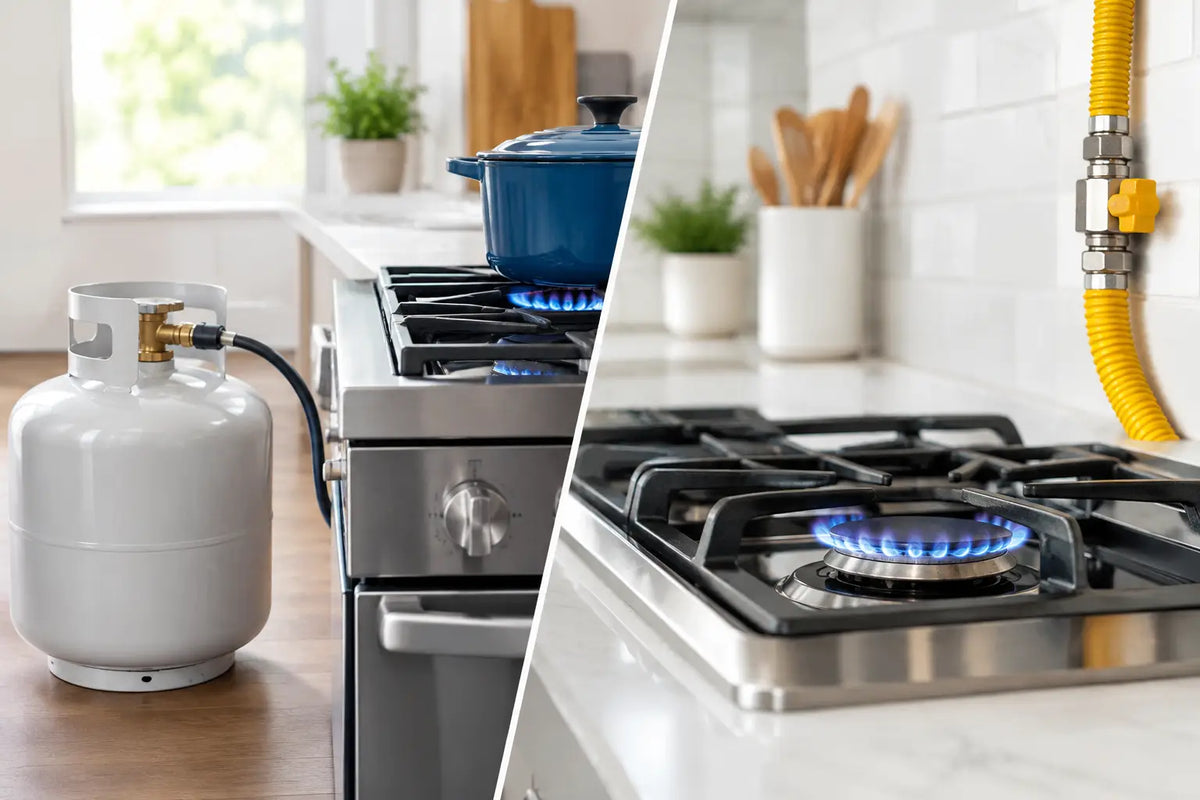
Natural gas arrives through a permanent utility line. It is generally available whenever the home’s service is active, which removes the routine of monitoring fuel levels and arranging cylinder exchanges. That uninterrupted supply is particularly appealing for high-use entertaining spaces, hospitality terraces, and homes where outdoor cooking is part of daily life.
Propane is stored on-site in a portable cylinder or a larger dedicated tank. It contains more energy per cubic foot than natural gas, so a propane appliance typically uses smaller burner orifices to achieve its rated output. The trade-off is simple: propane must be replenished. In return, the kitchen is not tied to an existing gas line.
A premium kitchen does not become less considered because it uses propane. With intelligent planning, the cylinder can be concealed within a ventilated cabinet or positioned in a compliant remote location, preserving the clean architectural profile of the entire installation.
Choose Natural Gas for Permanent, High-Use Spaces
Natural gas is often the strongest choice when an outdoor kitchen is being installed close to the home and will remain there for decades. It suits permanent patios, covered outdoor rooms, and hospitality environments where frequent use makes fuel management an unnecessary operational task.
The most obvious advantage is convenience. There is no tank gauge to check before guests arrive, no spare cylinder to store, and no interruption when a long Sunday lunch turns into an evening gathering. For homeowners who use a grill several times a week, that certainty has real value.
Natural gas can also make financial sense over time. Utility gas is often less expensive per unit of heat than exchanged propane cylinders, although pricing varies substantially by region, supplier, and delivery model. A household that grills occasionally may never recover the added installation cost. A household that cooks outdoors constantly may see a different equation.
The limitation is installation. A qualified gas professional must assess the route from the meter, pipe sizing, shutoff requirements, pressure, local code, and appliance demand. This is not a detail to solve after the kitchen has been delivered. A line that is undersized for a grill, power burner, and fire feature may compromise performance when multiple components run at once.
Natural gas also fixes the kitchen’s location. That can be entirely appropriate for a purpose-built terrace, but it offers less flexibility if you later redesign the landscape, move a modular unit to another zone, or take the kitchen to a new property.
The design question behind natural gas
A permanent fuel line rewards early planning. Before finalizing a kitchen configuration, map the gas route, electrical supply, drainage conditions, ventilation, appliance clearances, and access for future servicing. This is where a pre-assembled modular kitchen can be especially compelling: the cabinetry arrives as a finished architectural element, while the site work remains focused on properly preparing the utilities.
Choose Propane for Flexibility and Placement Freedom
Propane excels where a natural gas line is unavailable, expensive to extend, or incompatible with the property’s layout. It is a natural fit for detached garden kitchens, rooftop lounges, waterfront properties, cabins, vacation homes, and outdoor spaces where the kitchen may evolve with the landscape.
Its greatest strength is independence. A propane-ready grill can deliver high heat without requiring a trench across a finished patio or a connection back to the home. For many projects, this eliminates considerable installation complexity and allows the outdoor kitchen to sit where the view, circulation, and entertaining flow are best, rather than where the utility line happens to be.
Propane is also well suited to modular outdoor kitchen design. If a property changes hands, a terrace is renovated, or a hospitality venue reconfigures its guest areas, a modular system has a practical advantage over a masonry kitchen built permanently around a single location. The fuel source supports that flexibility.
The responsibility is fuel planning. Keep an eye on consumption, particularly when using high-output burners, griddles, or multiple appliances during large gatherings. Many experienced outdoor cooks maintain a second filled cylinder so an empty tank never ends a meal early. For properties with substantial demand, a larger external propane tank with scheduled supplier service may offer a more polished alternative to small portable cylinders.
Cold-weather performance and propane
Propane vaporizes less efficiently as temperatures drop. In extremely cold conditions, a small cylinder may struggle to provide adequate vapor flow for high-demand cooking, even when fuel remains inside. Tank size, weather exposure, and the total appliance load all matter.
This does not make propane unsuitable for four-season outdoor kitchens. It means the system should be specified properly. A larger tank, sensible placement, and a clear understanding of winter use can preserve dependable performance. Natural gas may be more consistent in severe cold, but the local climate and intended season of use should guide the decision.
Performance Depends on the Appliance, Not the Fuel Myth
One of the most persistent misconceptions is that propane automatically cooks hotter or that natural gas is inherently weaker. In reality, each appliance is engineered for a specific fuel type. A properly configured natural gas grill should reach its intended temperature range; a correctly configured propane grill should do the same.
What matters is the appliance rating, burner design, hood construction, heat retention, and the quality of the fuel supply. A premium grill connected to an undersized natural gas line can underperform. So can a propane grill paired with a nearly empty cylinder on a cold night.
Never assume an appliance can switch fuels without modification. Some grills can be professionally converted using a manufacturer-approved kit, while others cannot. Conversion should be completed only according to the appliance manufacturer’s instructions and applicable local requirements. An incorrect conversion affects safety, warranty coverage, emissions, and cooking performance.
For design-conscious buyers, compatibility deserves equal attention. The outdoor kitchen, grill cutout, ventilation strategy, access doors, and fuel connection must work together as one system. This is why selecting cabinetry and appliances as a coordinated specification is far superior to forcing a luxury grill into an improvised enclosure.
Installation, Safety, and the Details That Protect the Design
Outdoor fuel systems deserve professional attention, regardless of which option you choose. Natural gas piping should be installed and tested by a licensed professional. Propane cylinders and tanks require correct regulators, approved hoses, secure positioning, and ventilation that prevents gas from collecting inside an enclosure.
For propane, do not treat a cabinet as a sealed hiding place. A cylinder compartment must be designed for the purpose, with appropriate ventilation and access. For natural gas, locate accessible shutoff valves and ensure the gas line is protected from damage and compatible with the full connected load.
In both cases, follow appliance clearance requirements and local building and fire regulations. This matters even more beneath covered structures, near combustible finishes, or in dense urban settings. The most beautiful outdoor kitchen is only truly successful when its performance and safety are engineered into the design from the beginning.
Let the Property Decide
Choose natural gas when the kitchen has a permanent home, the utility connection is straightforward, and uninterrupted daily-use convenience is the priority. Choose propane when placement freedom, simpler site preparation, and modular adaptability matter more than an always-on utility line.
For an elevated outdoor kitchen, the fuel source should never dictate a compromise in design. ELEEXA modular systems are designed to make the finished space feel intentional, composed, and ready to enjoy, whether the project calls for the permanence of natural gas or the freedom of propane. Start with how you want people to move, gather, cook, and stay outside after dark. The right fuel choice becomes much clearer from there.